


More than 1,249 families trust us
Interactive games for elementary school: learn, practice and enjoy
Interactive games for elementary school students are an effective way to reinforce school content while children have fun. Through play, they improve memory, attention, reasoning, and comprehension, making studying more motivating and natural.


What are interactive games for elementary school and why do they work?
Interactive games for primary school students are digital or hands-on activities that combine challenges, visual stimuli, and guided practice. They are designed to help students reinforce knowledge through action, not just memorization.
By integrating instant feedback , progressive levels , and clear objectives , these games increase motivation and engagement. Furthermore, they connect with basic principles of neuroscience:
Spaced repetition facilitates long-term consolidation.
Positive reinforcement activates reward circuits.
Visual + verbal interaction improves comprehension.
In primary school, where curiosity is at its peak, this format allows children to learn almost without realizing it.

Educational benefits of interactive games in primary school
Interactive games offer benefits that go beyond entertainment. They are an educational tool with a direct impact on performance and cognitive development.
Main benefits:
They improve motivation : each completed challenge fuels the desire to continue learning.
They reinforce school subjects : mathematics, reading, grammar, English, science…
They train cognitive skills : memory, attention, logical reasoning, processing speed.
They promote autonomy : students learn to manage their own progress.
They reduce frustration : games allow you to make mistakes and try again without pressure.
When properly integrated, these games become a real support for classroom work and home study.

Types of interactive games ideal for elementary school students
There are multiple categories of interactive games adapted to each stage of primary school. Choosing the right ones allows for balanced reinforcement of learning.
The most useful ones for this age are:
Math games: calculation, problems, logic, equivalences, basic geometry.
Reading and language games: comprehension, written expression, grammar, vocabulary.
English games: basic listening, vocabulary, simple structures.
Cognitive games: visual memory, sustained attention, reasoning, mental speed.
Planning and organization games: ideal for preparing for exams.
Many of these games combine curriculum content with playful activities, making them perfect for both reviewing and discovering new skills.

How to integrate interactive games into daily study in a balanced way
Interactive games don't replace studying, but they do enhance it. When integrated with structure and balance, they help create positive routines.
Practical recommendations:
Short, frequent sessions: 10–15 minutes a day work better than long sessions.
Use them as a warm-up before studying: they activate attention.
Mix content-based games and cognitive games: both offer different benefits.
Avoid turning it into pointless screen time: there must be a clear objective.
Track your progress: seeing improvements increases motivation.
Including interactive games in the school routine is a natural way to reinforce learning without generating rejection.


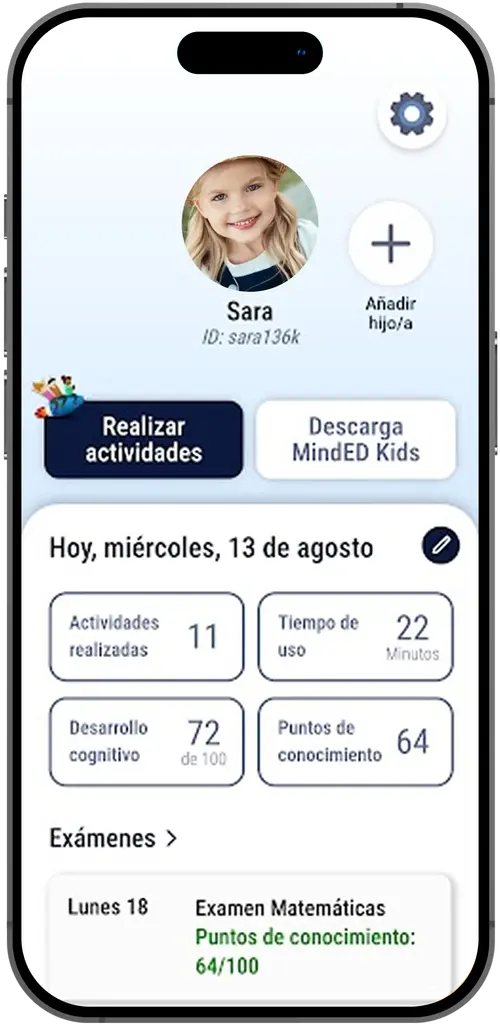
Make learning fun with interactive games for elementary school students: discover MindED
Kids love it! Parents trust us!
More than 1,249 families trust us


Carmen R.
March 15, 2025

Alejandro M.
February 2, 2025

María José L.
April 28, 2025

Carlos P.
June 12, 2025



Frequently asked questions about interactive games for elementary school
Are interactive games effective for elementary school children?
Yes. By combining practice, motivation, and repetition, interactive games reinforce learning and improve essential cognitive skills.
What type of games are most recommended?
Those that include curriculum content, progressive challenges, and immediate feedback. If they also work on memory, attention, or logic, the benefit is twofold.
How much playing time is appropriate each day?
Between 10 and 20 minutes a day is enough to notice improvements without overloading the children.
Can they improve school performance?
Yes. Many students improve their grades, comprehension, and confidence when they supplement their studies with interactive games tailored to their level.
Make learning fun with interactive games for elementary school students: discover MindED